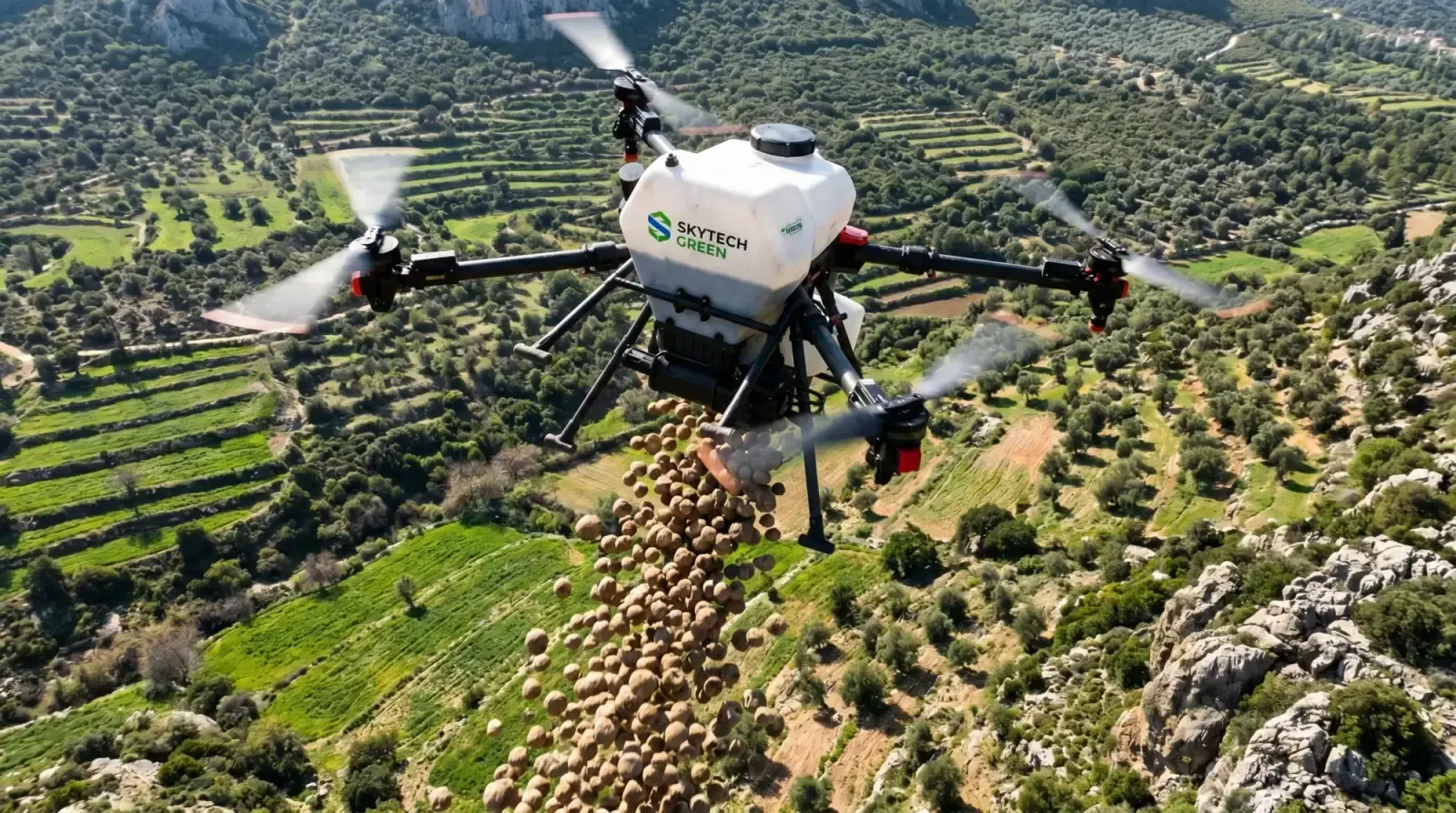
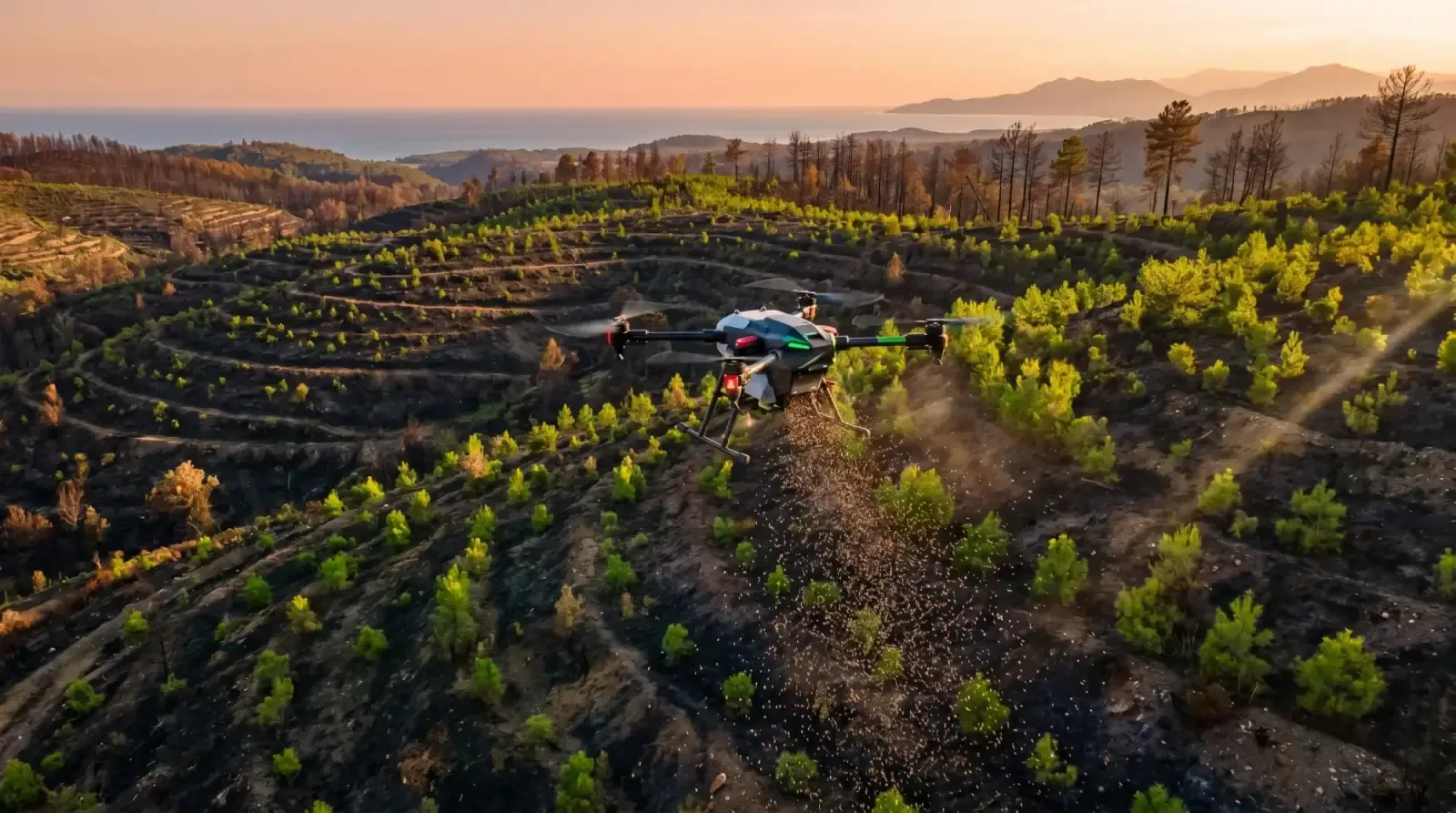
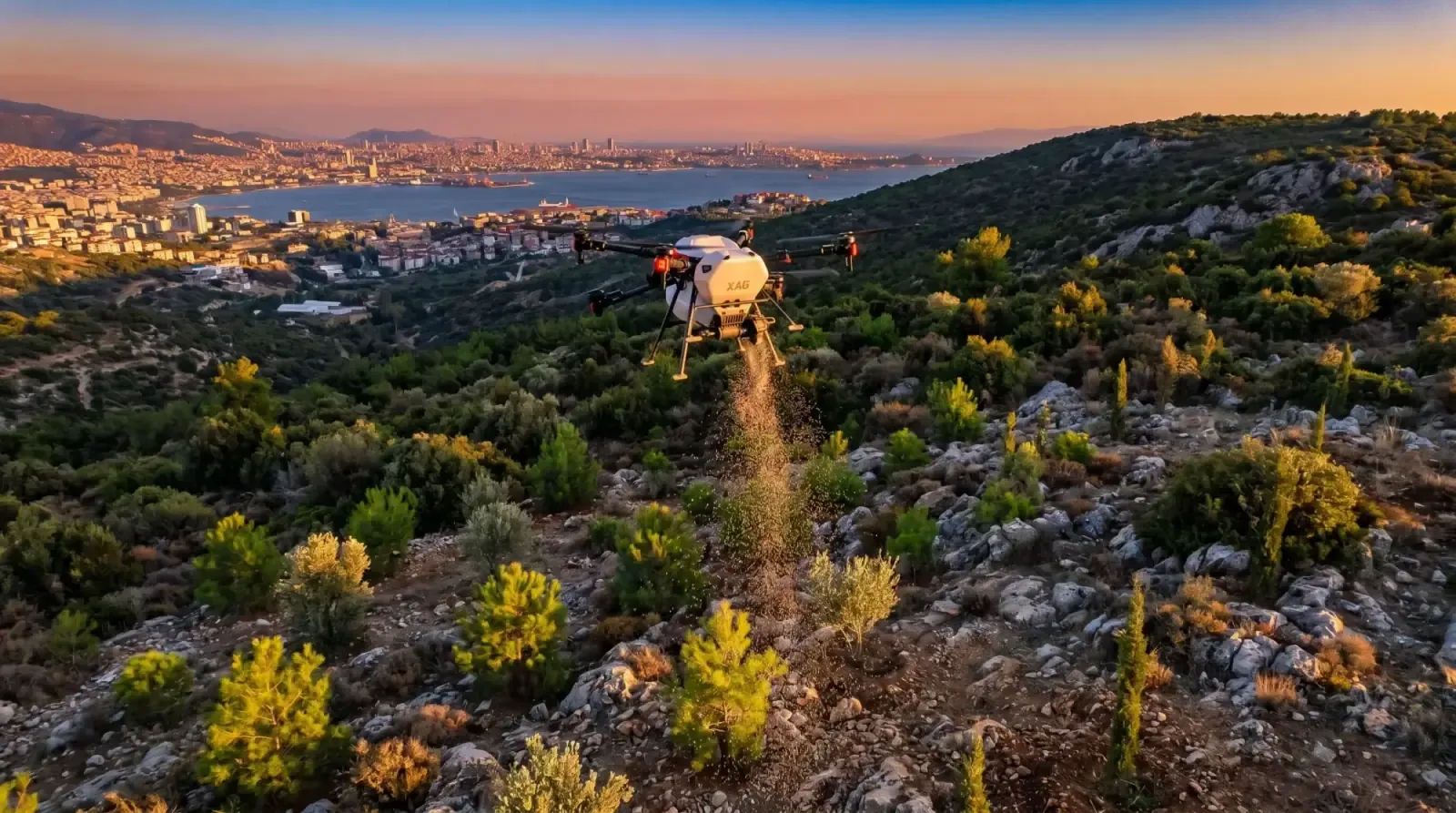
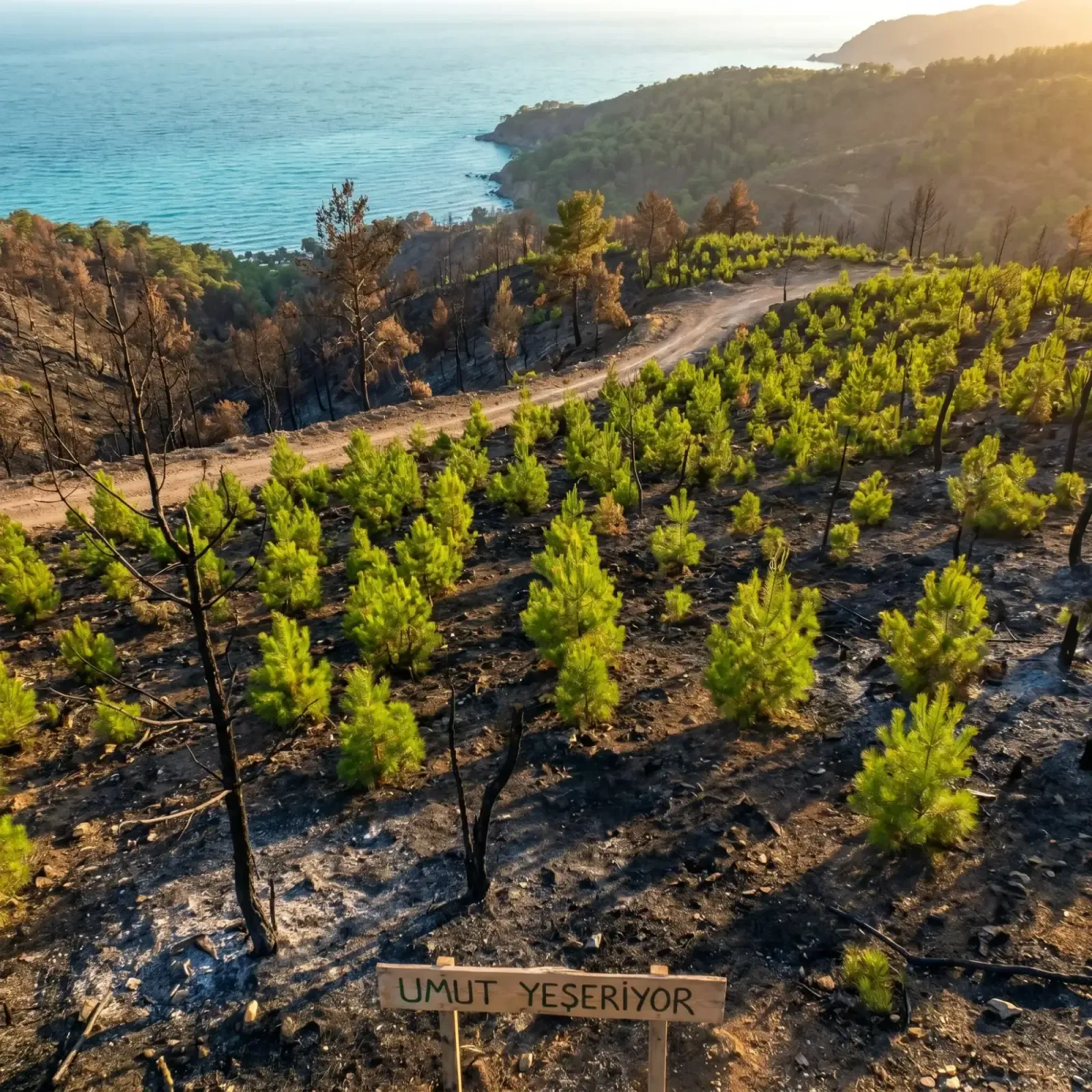
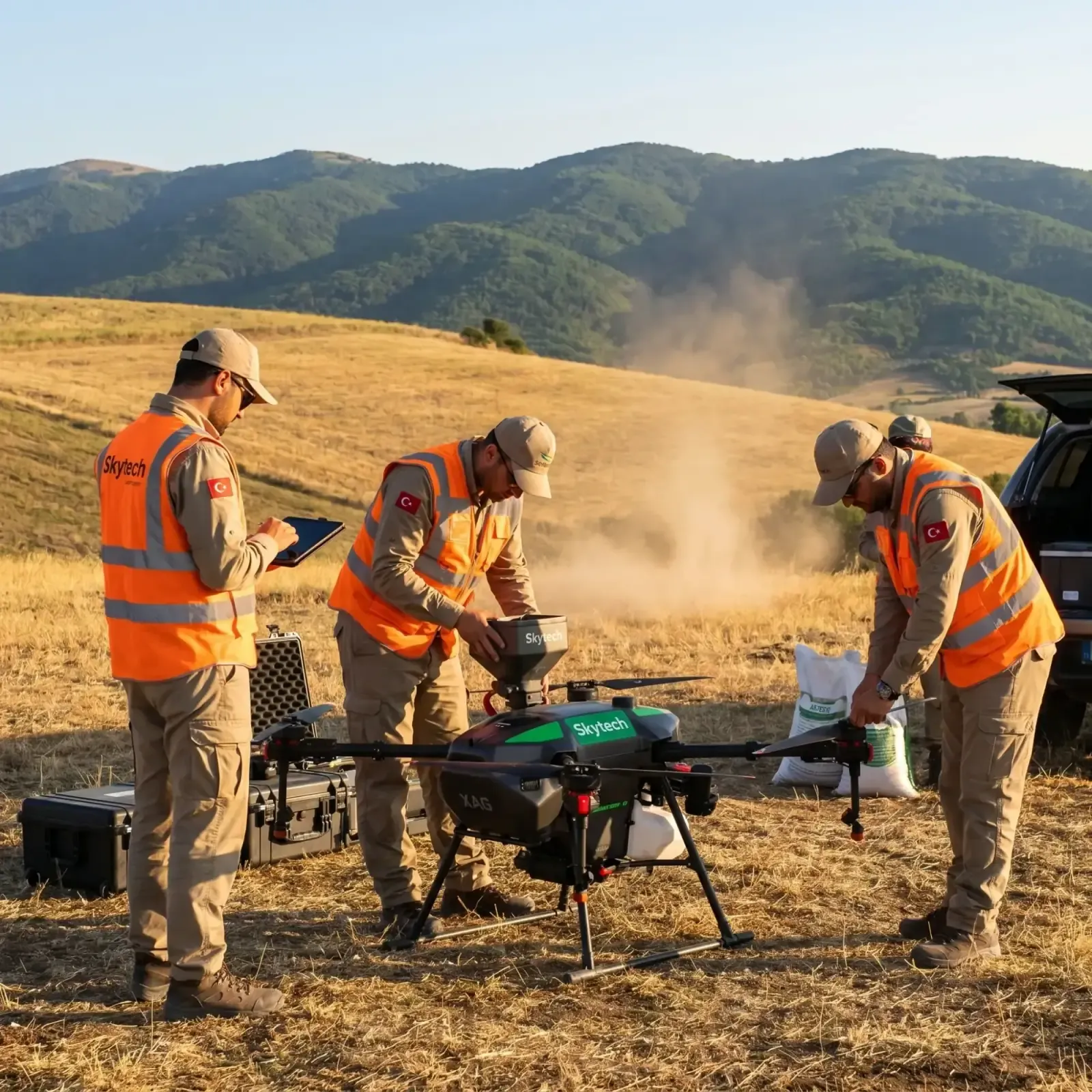
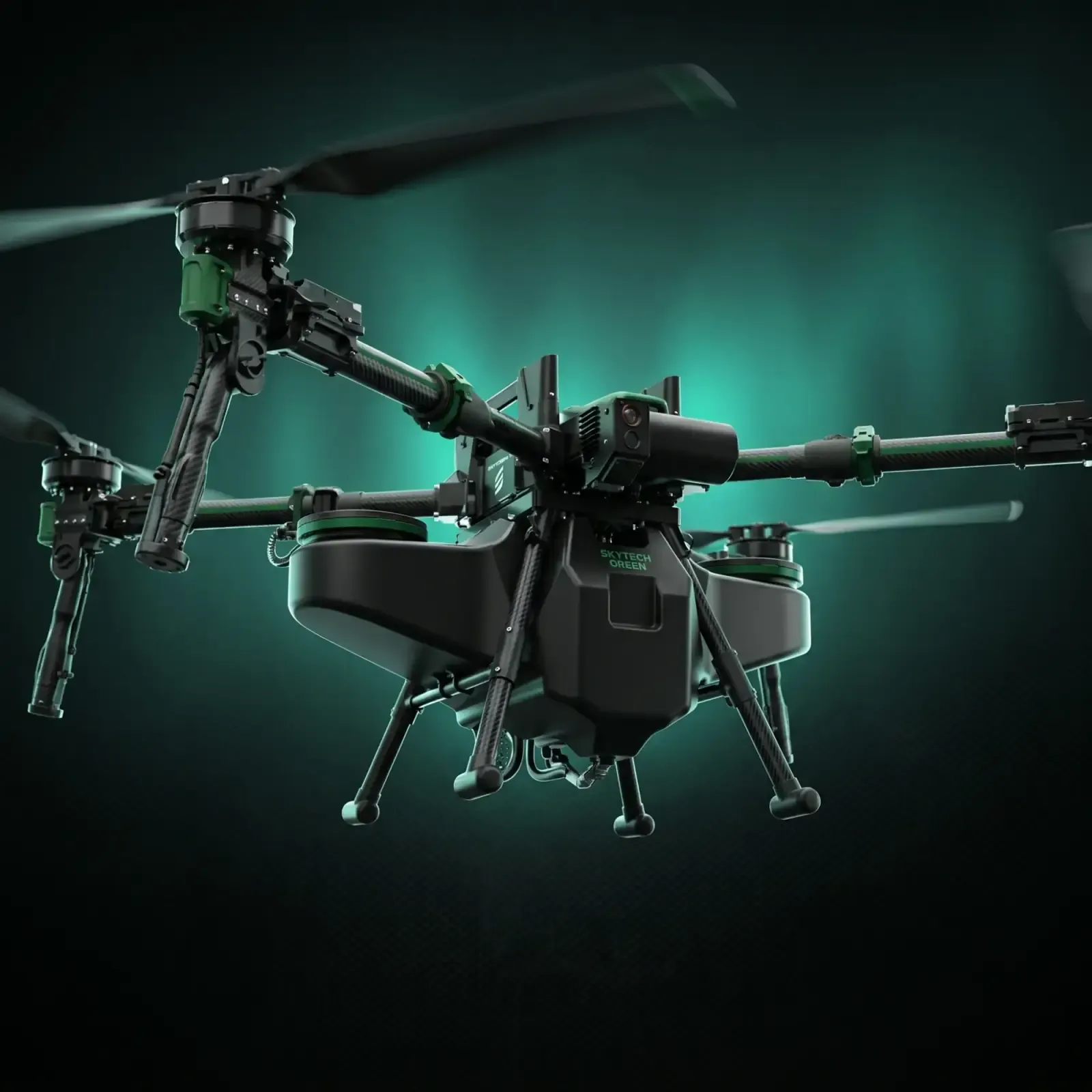
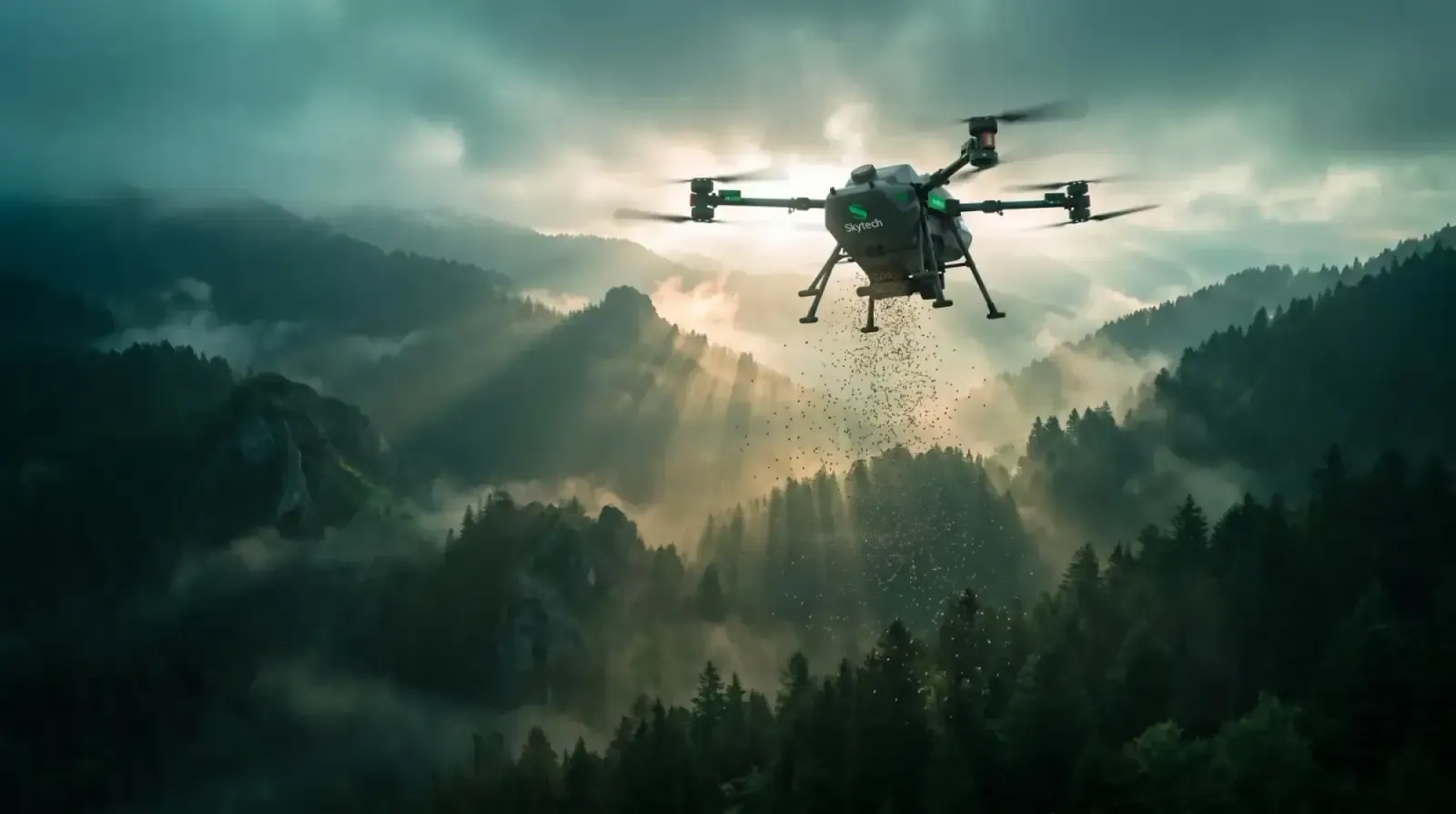
Skytech Green grew out of applying the precision-sowing capability built inside Air to ecological restoration. Its drone fleet sows seed balls across burnt ground and slopes that ground crews struggle to reach.
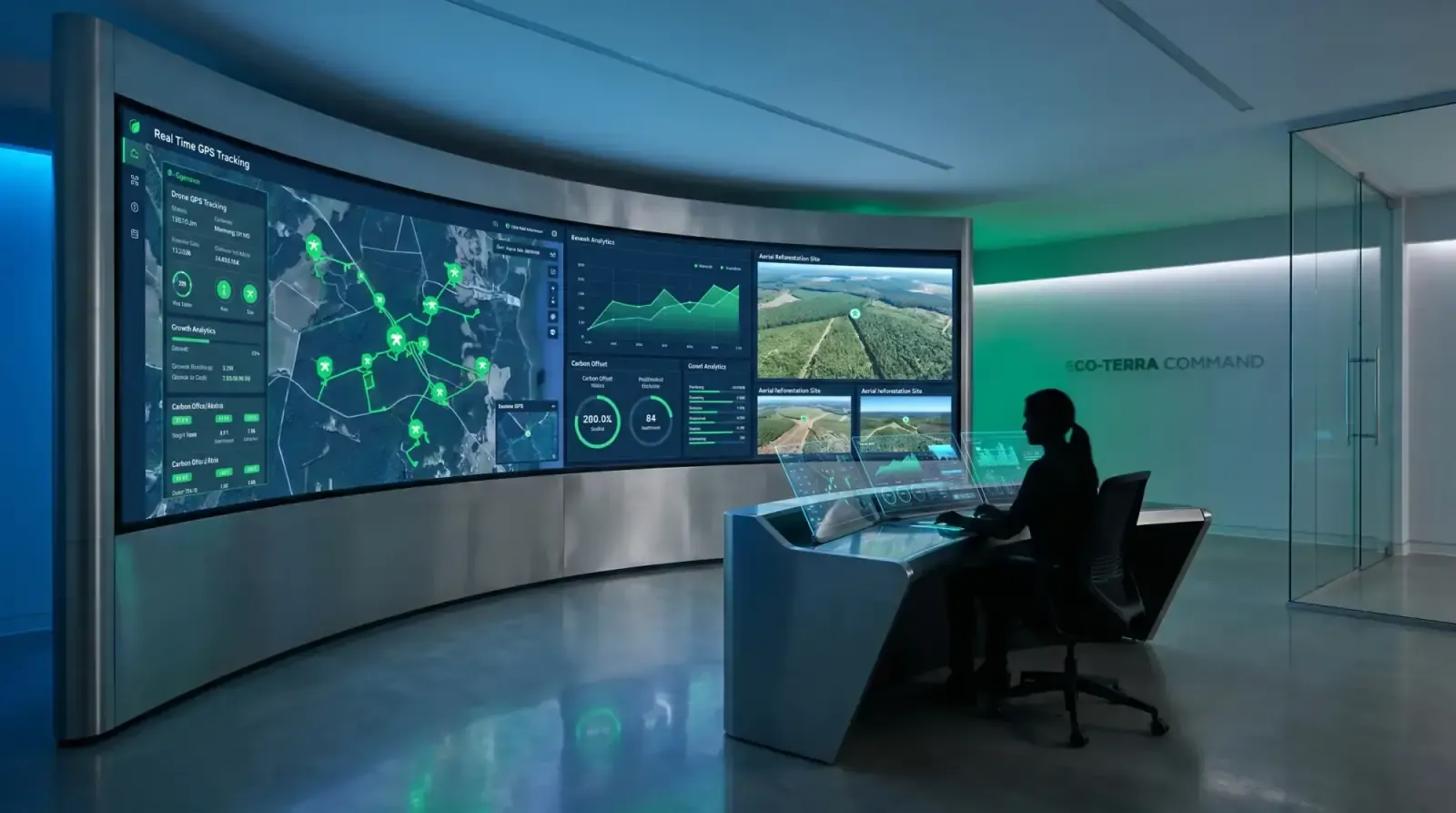
Every sowing run is GPS-logged: which coordinate received how many seed balls, of which species. That record makes both multi-year monitoring of the site and an auditable carbon-offsetting certificate for corporate clients possible.
A capsule of clay, organic nutrient and native seed
How the work is done
A seed ball keeps the seed alive until it germinates
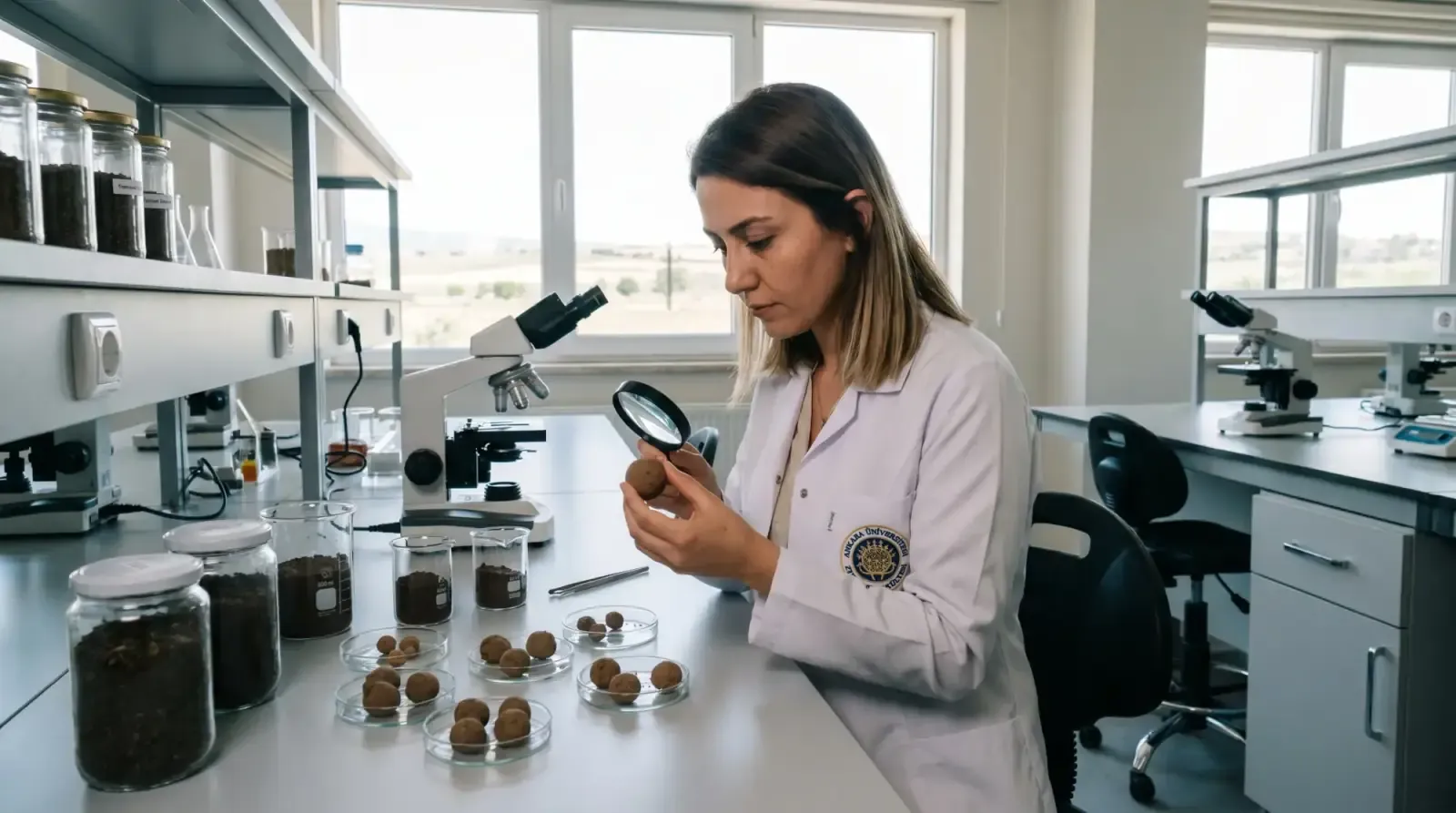
A seed ball encapsulates plant seed in clay and organic nutrient, shielding it from the elements. The coating protects the seed from drought and from birds and rodents, and helps it hold to the ground.
Rain dissolves the clay and the seed sprouts. That protection lifts the germination rate above 65% — roughly three times what broadcasting bare seed from the air achieves.
Formulation is species-specific. Clay ratio, organic nutrient content and capsule diameter are set against the seed size of the species and the soil structure of the site.
The native species we use
Species are chosen for the site’s climate, altitude and soil. Seed is sourced from Provincial Forestry Directorate production facilities.
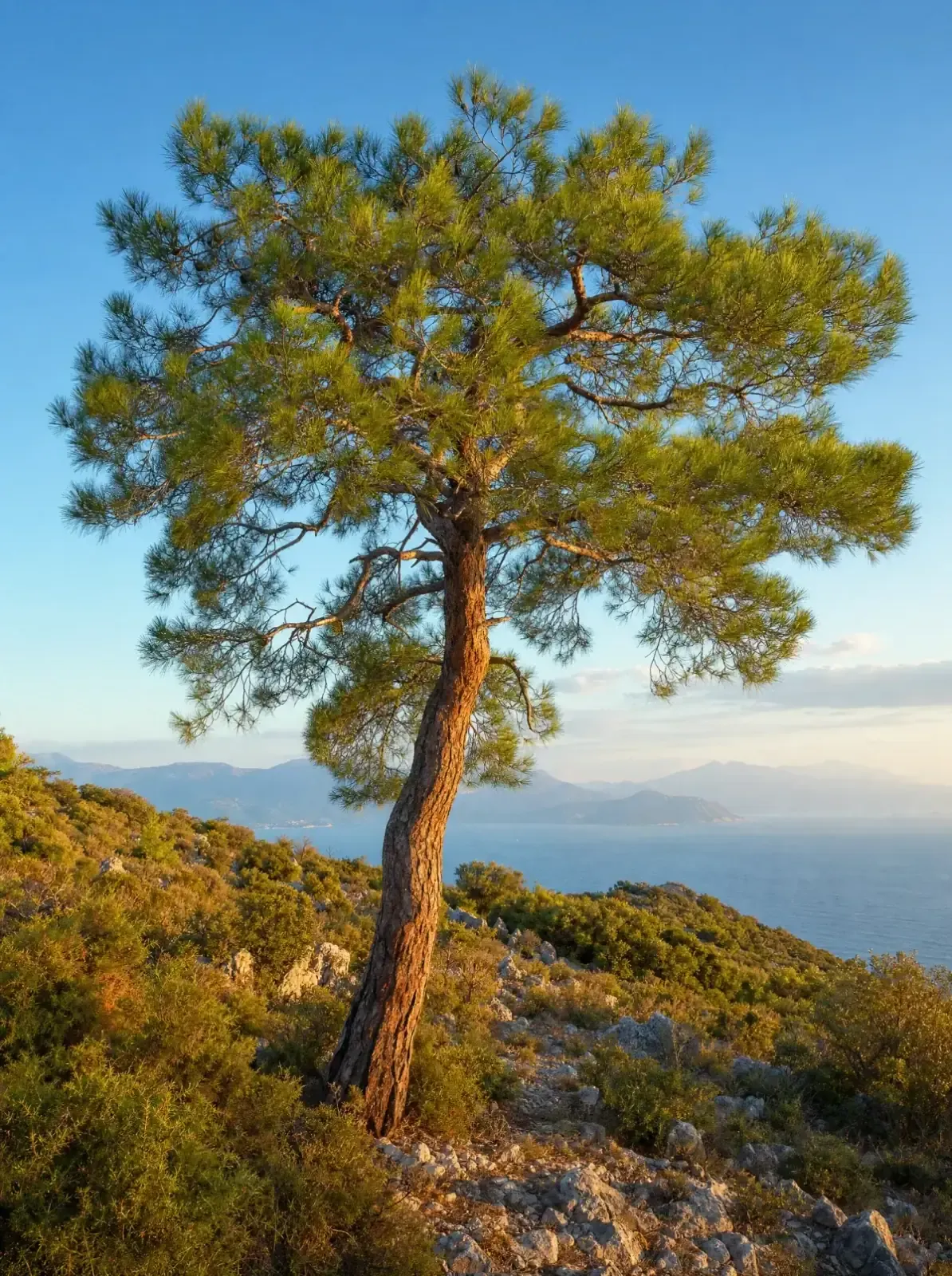
Turkish red pine · Pinus brutia
The most widespread conifer in Türkiye, covering roughly a quarter of its forest area. Well adapted to the Mediterranean climate, fast growing, and known for regenerating naturally after fire.
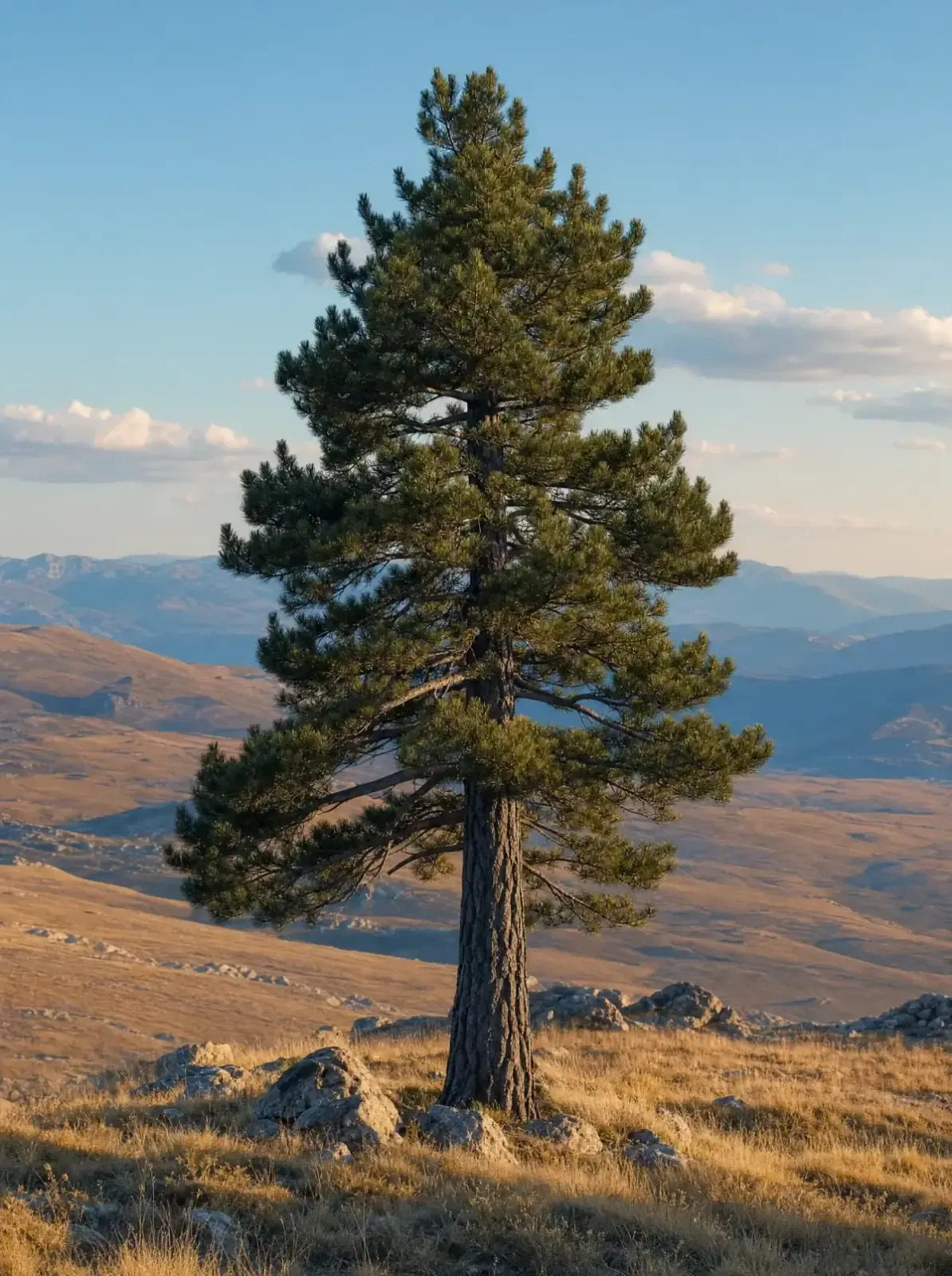
Austrian pine · Pinus nigra
The pioneer species of high-altitude afforestation. It plays a critical role in erosion control and across the steppe–forest transition zone.
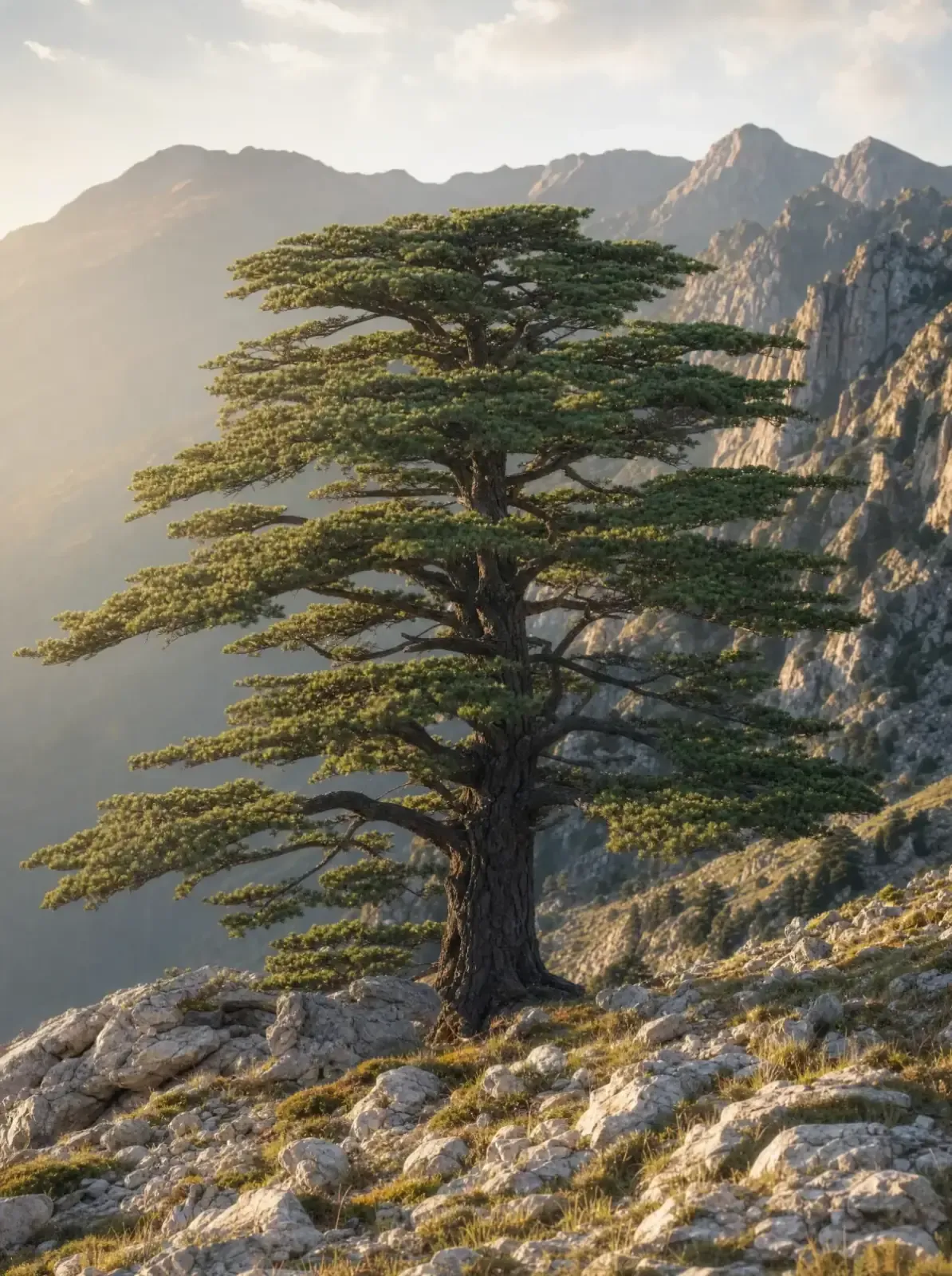
Lebanon cedar · Cedrus libani
An emblem of Anatolia and a heritage tree with a lifespan measured in centuries. It forms pure stands at high altitude and tolerates drought well.
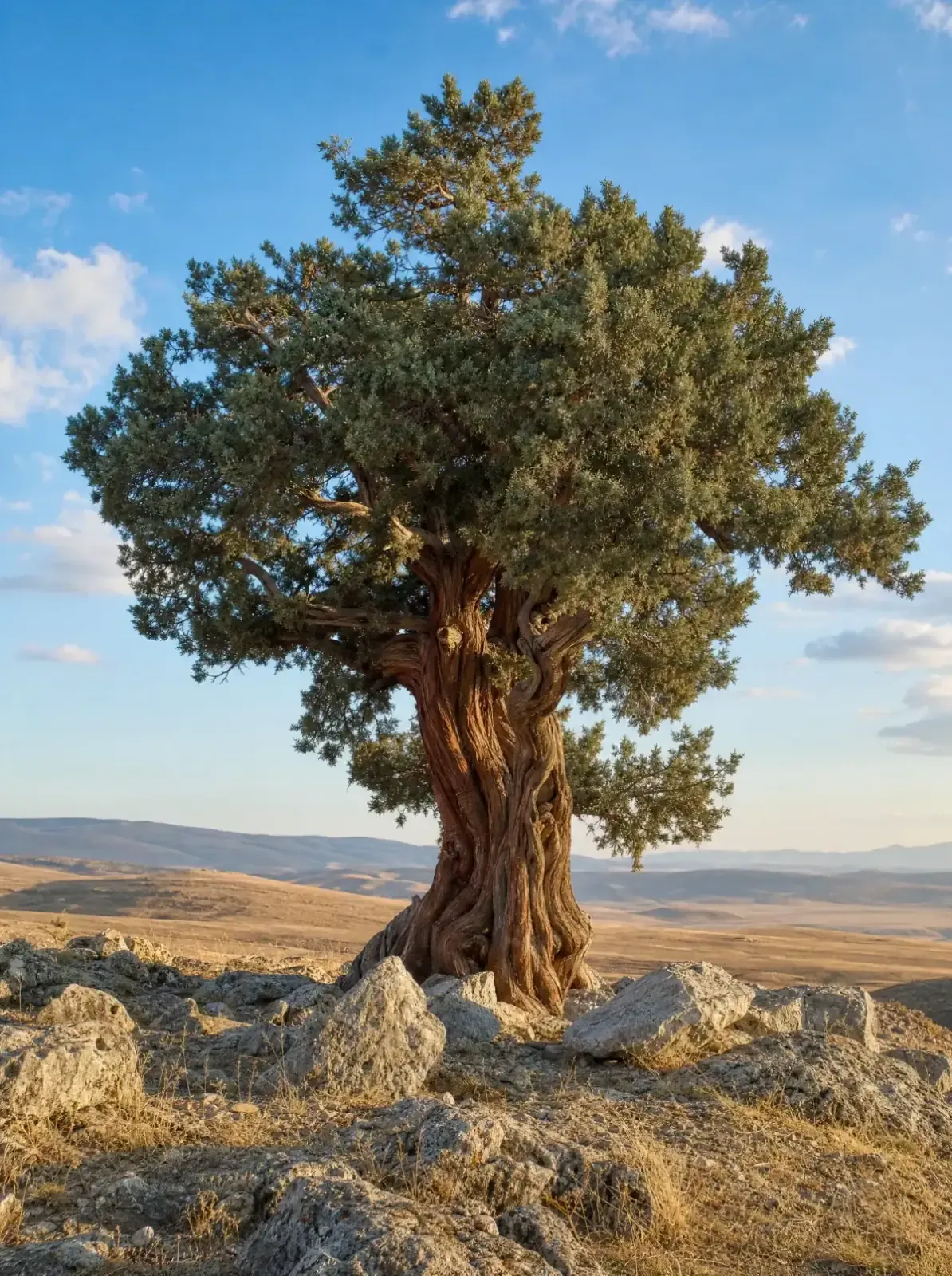
Juniper · Juniperus
The species for hard, arid sites. Slow growing, but it survives on stony, shallow soils where nothing else takes hold.
How a project runs
Sowing is one step of the process. Without the research before it and the monitoring after it, the result cannot be measured.
01
Research and species selection
Our forest engineers and academic advisers set a species mix suited to the site’s climate and ecology. Selection differs between post-fire land and mine-site rehabilitation.
02
Site analysis
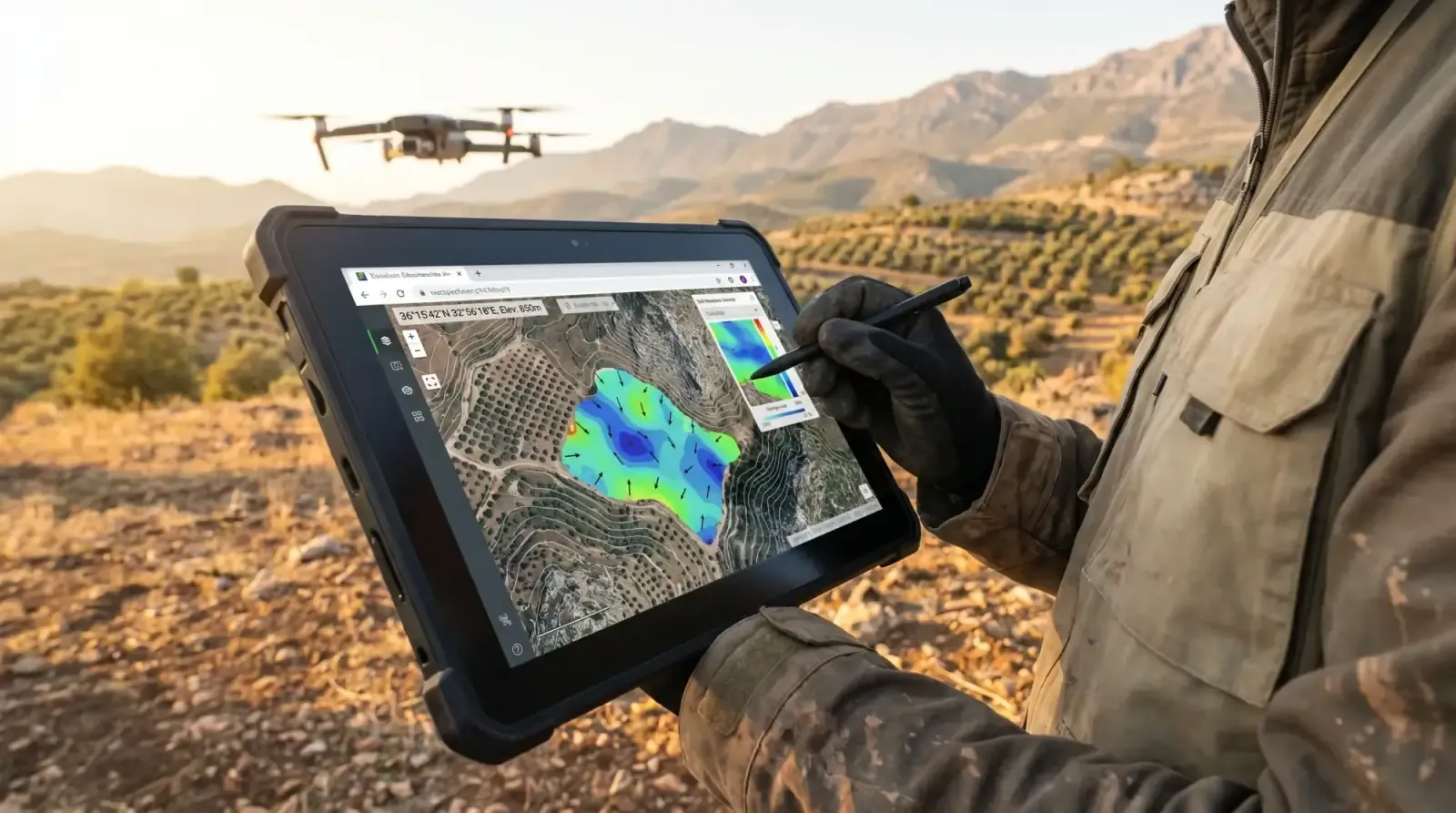
Topography, soil moisture and existing vegetation are assessed from satellite and drone imagery, and the best target points for sowing are derived. Permits are coordinated with the Provincial Forestry Directorate.
03
Drone sowing
The GPS-guided fleet places more than 200 seed balls onto predetermined coordinates in a single flight. Because no vehicle or crew enters the site, there is no ground disturbance.
04
Monitoring
The site is re-surveyed each year by drone photogrammetry. Vegetation development is measured and written to the corporate dashboard, and the data can feed ESG reporting.
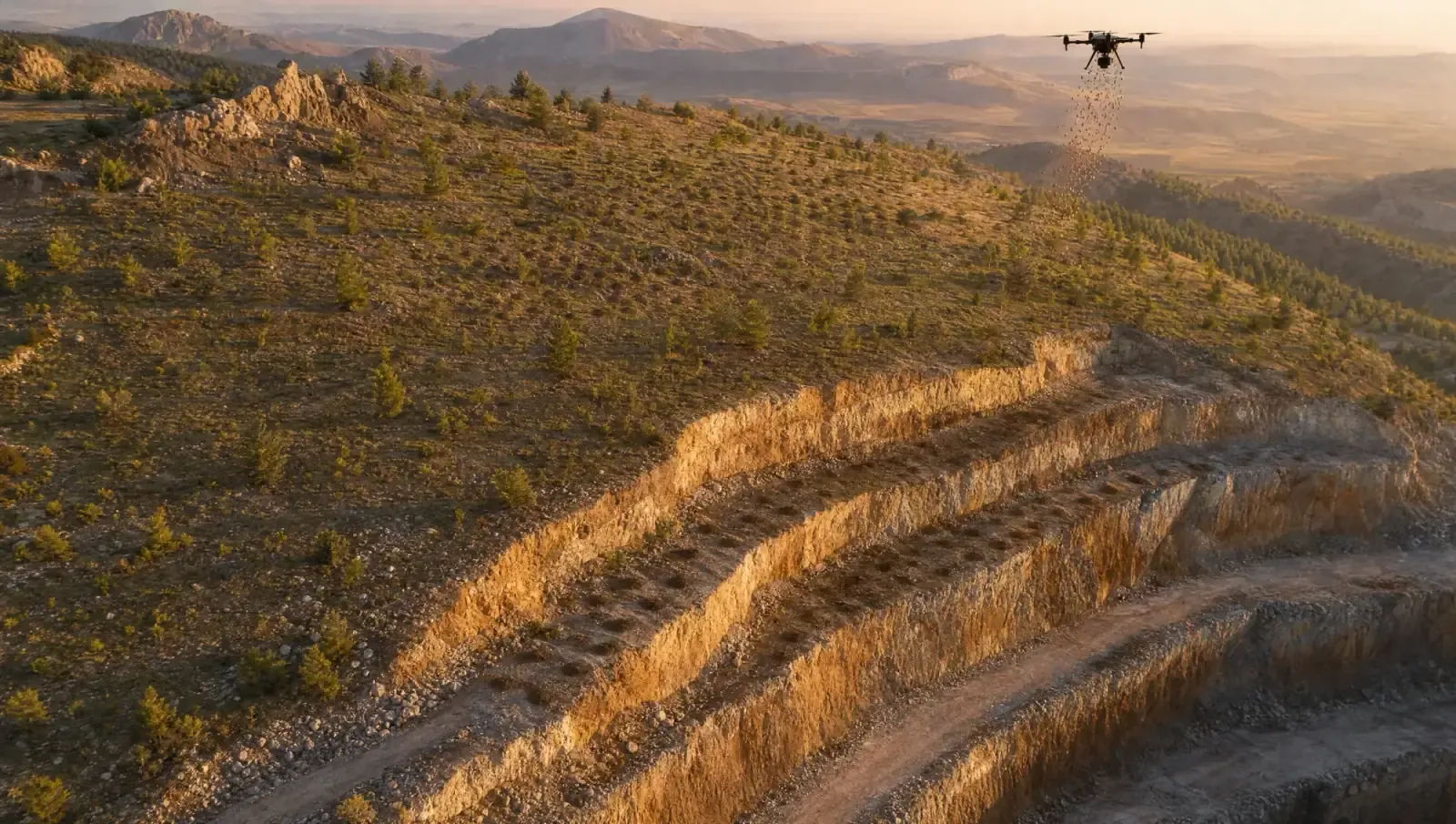
A mine site undergoing rehabilitation
Three kinds of site, three different problems
Post-fire land. Ground cover is weakened on burnt forest land and erosion begins with the first rains. Speed matters, and a drone fleet covers a wide area quickly.
Mine sites. Where mining has degraded vegetation and soil structure, restoration means addressing species selection and soil condition together.
Erosion zones. Steep slopes with difficult access — the condition where hand planting is most expensive and the drone most advantageous.
Measurement framework
These are published ranges from the scientific literature. Carbon removal varies by species, age, climate and site; corporate projects update them with site-based measurement.
Germination rate
Above 65% with seed balls (~3× broadcasting bare seed)
Sowing capacity
200+ seed balls per flight
Speed
Roughly 10× hand sowing
Carbon per tree
10–25 kg CO₂ / year (by species and age)
Removal per hectare
4.5–40.7 t CO₂ / ha / year (first 20 years, literature range)
Records
Coordinate, species and date per sowing point; annual photogrammetry
Reporting
ESG output aligned to GRI, CDP and SASB
Supply chain and legal framework
Seed is sourced from Provincial Forestry Directorate production facilities. Species, collection date and origin are recorded for every batch — where a given seed came from is documented, not assumed.
Afforestation and carbon-sink projects run in coordination with the Regional Directorates of the General Directorate of Forestry. Academic advice is provided by Karadeniz Technical University and Artvin Çoruh University.
These programmes are not a donation. They are a service whose output is documented, measured and reported.
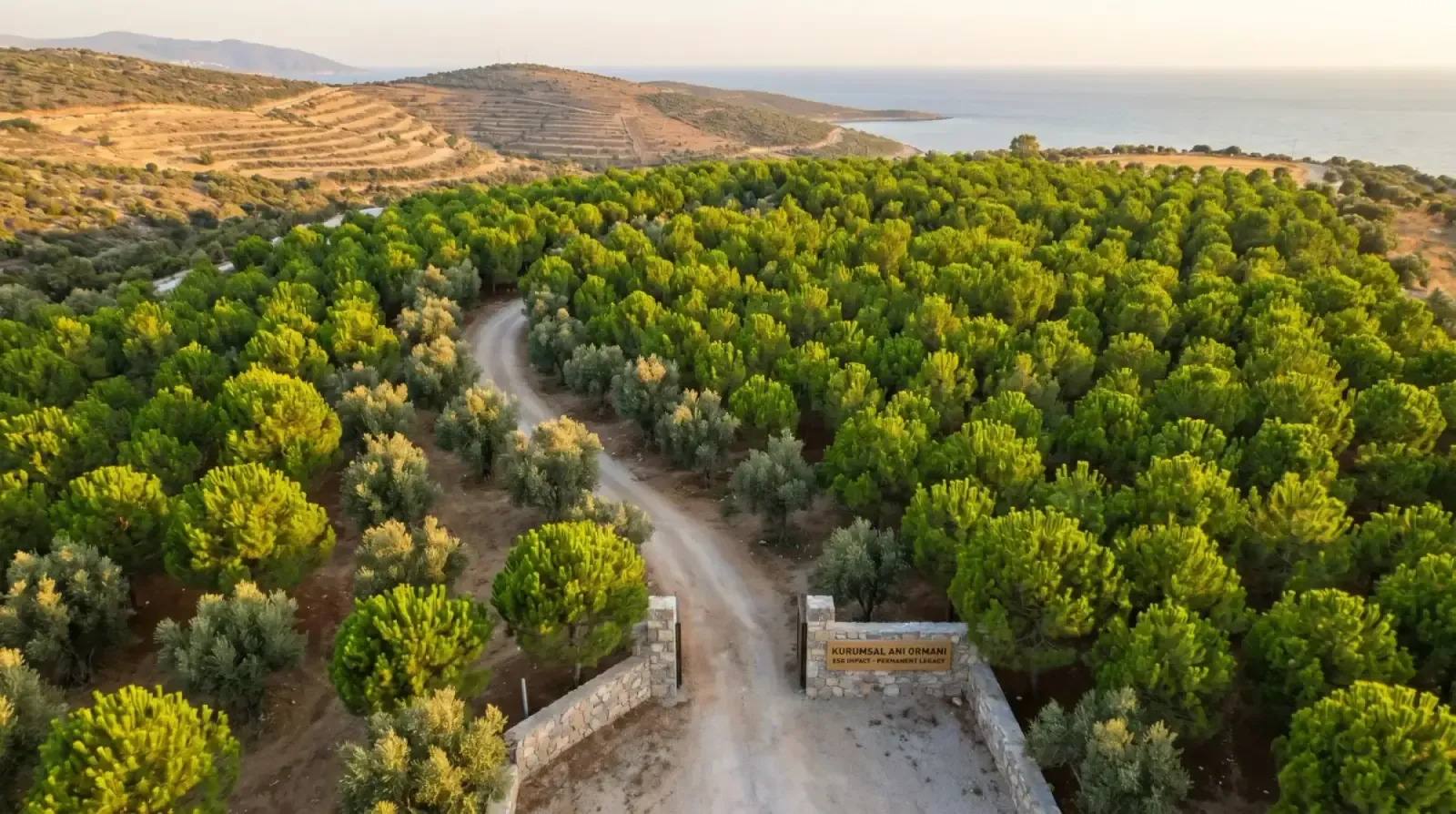
A corporate legacy-forest site
Corporate programmes
Companies can establish a legacy forest in the name of their employees, their customers or an event. A digital certificate is issued per employee, and the site’s location, scale and monitoring status are reported.
On the offsetting side, annual emissions are calculated and the sowing area corresponding to that balance is defined. The result is documented in a form usable in GRI and CDP submissions and in corporate sustainability statements.
Data reaches you through the corporate dashboard and, on request, through an API into your own ESG software.
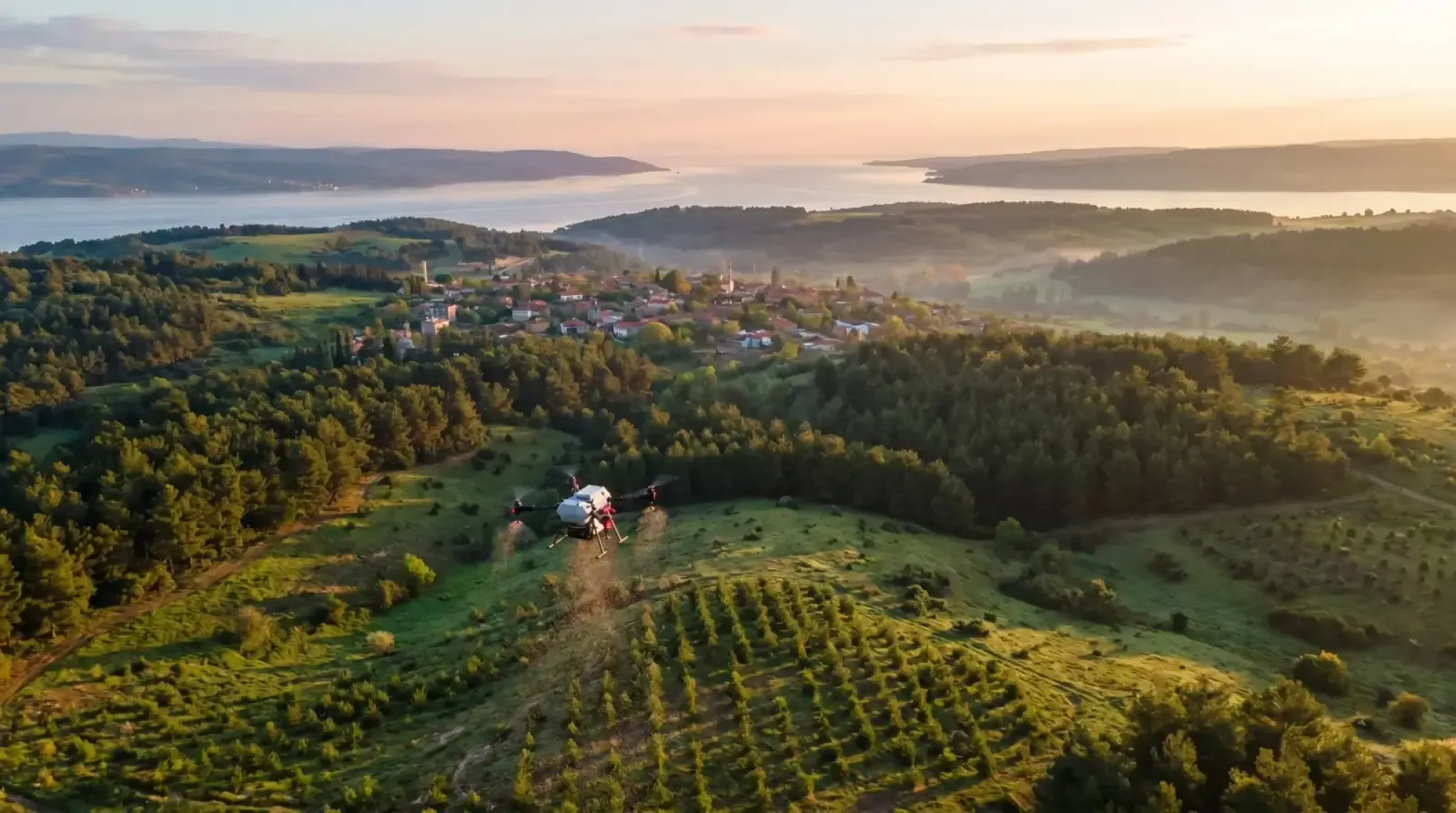
From the sites
Honest limits
Seed-ball sowing does not replace conventional sapling planting. It is complementary, suited to different terrain and scales, and it is at its best where access is hard, slopes are steep and the area is large.
Carbon offsetting depends on how much of the sown area establishes over time. It is a process to be monitored rather than a one-off transaction — which is why annual monitoring is part of the contract.
Germination varies with site conditions. The 65%+ figure is a published rate for the seed-ball method, not a result guaranteed for every site.
We work at pilot sites across Türkiye; Çanakkale, İzmir and Bursa are our active pilot regions.
Capabilities
What this division does
The services and engineering scope we deliver.
Seed-ball production
Species-specific formulation of soil, clay and nutrients, with a coating that lifts germination rates.
Precision drone sowing
High-tempo aerial sowing over burnt areas and slopes with difficult ground access.
GPS-logged monitoring
Each sowing point is recorded by coordinate, and the site is tracked over subsequent years.
Carbon offsetting
Measurable impact reporting and certification that slots into corporate ESG disclosures.
Legacy Forest
Corporate forests created in the name of a company’s employees, customers or events.
Individual programmes
Take part directly through “sow it yourself” or “we sow it for you” options.
Platform
Digital platform
SITEskytechgreen.comProgramme, technology and project map
APPapp.skytechgreen.comOrdering, corporate dashboard and reporting
Sectors
Where we work
Corporate ESG programmes
Municipalities and public sector
Post-fire restoration
Erosion control
Mine-site rehabilitation
Individual participation
From the field
Operating basis
How we operate
Seed is sourced from Provincial Forestry Directorate production facilities; batch number, production date and species are on record.
All projects run under legal permits and in coordination with the relevant authorities.
These programmes are a service with documented output, not a donation.
A seed ball is a sowing unit made by embedding species-specific seed in a mixture of soil, clay and nutrients. The coating protects the seed between sowing and germination. Skytech Green disperses these balls by drone across slopes and burnt ground that ground crews struggle to reach.
Does seed-ball sowing replace conventional sapling planting?
No. Seed-ball sowing does not replace conventional sapling planting; it is complementary, suited to different terrain and different scales. It offers an advantage in speed and access where ground access is difficult, slopes are steep and the area is large.
Can the carbon offsetting certificate be included in an ESG report?
Yes. Skytech Green issues a certificate based on the area sown, the species mix and the coordinate log, and it can be included in corporate ESG disclosures. Because offsetting depends on how much of the sown area establishes over time, it is a process to be monitored rather than a one-off transaction.
Where does the seed come from?
Seed is sourced from Provincial Forestry Directorate production facilities. Batch number, production date and species are on record. All projects run under legal permits and in coordination with the relevant authorities.
Have an enquiry for this division?
Reach our technical team and we will size the solution and prepare a quote.
 SKYTECH GREEN